Message: #0 2026-02-18 
Python has become the undisputed "lingua franca" of Artificial
Intelligence (AI) and Machine Learning (ML). While other languages
like C++ or Julia are faster in raw execution, Python wins because it
acts as the perfect **orchestrator**.
To use your earlier metaphor: if the "Encyclopedia" is the vast
collection of data, Python is the "Cycle" that processes it and the
"Fan" that powers the internal logic of the model.
---
### 1. The "Glue Language" Philosophy
Python is a high-level language, meaning it is easy for humans to read
but slower for computers to execute. However, AI requires massive
mathematical computations.
Python solves this by acting as **glue**. The heavy lifting (the
matrix multiplication) is written in **C or C++**, while Python
provides a simple interface to trigger those high-speed "internal
revolutions." When you run a command in Python, you are often just
telling a highly optimized C++ engine what to do.
### 2. The Core Ecosystem (The Tools)
The reason Python dominates is its specialized library ecosystem.
These libraries represent the "content of what has happened" in the
field:
* **NumPy:** The foundation. It handles multi-dimensional arrays and
high-level mathematics. Without NumPy, Python couldn't handle the
"coin of words" or data points.
* **Pandas:** Used for data manipulation. Think of this as the index
of the Encyclopedia—it organizes messy data into structured tables.
* **Scikit-Learn:** The go-to library for traditional Machine Learning
(regression, classification, and clustering).
* **TensorFlow & PyTorch:** These are the "engines" for Deep Learning
(Neural Networks). They allow for the creation of complex systems that
mimic human thought patterns.
---
### 3. Why Python Fits Your "Cycle" Logic
In AI development, the workflow is a literal **cycle** known as the
**ML Pipeline**. Python is uniquely designed to handle every stage of
this repetition:
1. **Data Ingestion:** Gathering the "words."
2. **Preprocessing:** Cleaning the "Encyclopedia."
3. **Modeling:** Setting the "Fan" in motion to find patterns.
4. **Evaluation:** Checking if the internal revolutions match
reality.
5. **Deployment:** Starting the cycle over with new data.
---
### 4. Mathematical Integration
AI is essentially and . Python’s syntax allows researchers to write
code that looks almost exactly like the mathematical formulas found in
academic papers.
For example, a simple weight update in a neural network can be
expressed as:
In Python, the code to implement this remains clean and readable,
allowing the "internal revolution" of the algorithm to be audited and
understood by humans easily.
---
### 5. The Future (The "Expected Future Ven")
Python is currently the bridge to **Generative AI** (like the models
powering our conversation). Because it is the primary language for
Large Language Models (LLMs), any future breakthroughs in "artificial
consciousness" or complex reasoning will likely be coded in Python
first. It has become the "Encyclopedia" of modern engineering
knowledge.
**Would you like to see a simple code example of how Python creates
one of these "cycles" by predicting a future value based on past
data?**
To demonstrate how Python creates the "cycle" you described—taking
the "coin of words" (data) and turning it into an "expected future"
(prediction)—we can look at a **Linear Regression** model.
This is the simplest form of "internal revolution." The machine
rotates through the data points until it finds a line that best fits
the pattern.
### 1. The Code (The "Coin of Words")
In Python, we use a library called `scikit-learn`. Here is how we
define a simple relationship:
```python
from sklearn.linear_model import LinearRegression
import numpy as np
# Data: The "History" (e.g., hours studied vs. exam score)
# This is our Encyclopedia of past events.
X = np.array([[1], [2], [3], [4], [5]])
y = np.array([10, 20, 30, 40, 50])
# The Model: The "Fan"
# It revolves internally to find the pattern.
model = LinearRegression()
model.fit(X, y)
# The Prediction: The "Expected Future"
# We ask about a time that hasn't happened yet (6 hours).
future_event = np.array([[6]])
prediction = model.predict(future_event)
print(f"The expected future value is: {prediction[0]}")
from sklearn.linear_model import LinearRegression
import numpy as np
# Data: The "History" (e.g., hours studied vs. exam score)
# This is our Encyclopedia of past events.
X = np.array([[1], [2], [3], [4], [5]])
y = np.array([10, 20, 30, 40, 50])
# The Model: The "Fan"
# It revolves internally to find the pattern.
model = LinearRegression()
model.fit(X, y)
# The Prediction: The "Expected Future"
# We ask about a time that hasn't happened yet (6 hours).
future_event = np.array([[6]])
prediction = model.predict(future_event)
print(f"The expected future value is: {prediction[0]}")
```
---
### 2. How the "Internal Revolution" Works
When `model.fit(X, y)` is called, the computer performs a mathematical
cycle. It isn't just "guessing"; it is minimizing the **Loss
Function**.
Imagine the "Fan" spinning. Each rotation adjusts the "angle" of the
prediction line. It calculates the error (the distance between its
guess and the real data) and uses **Gradient Descent** to correct
itself.
The math behind this "cycle" looks like this:
$$J(\theta) = \frac{1}{2m} \sum_{i=1}^{m} (h_\theta(x^{(i)}) -
y^{(i)})^2$$
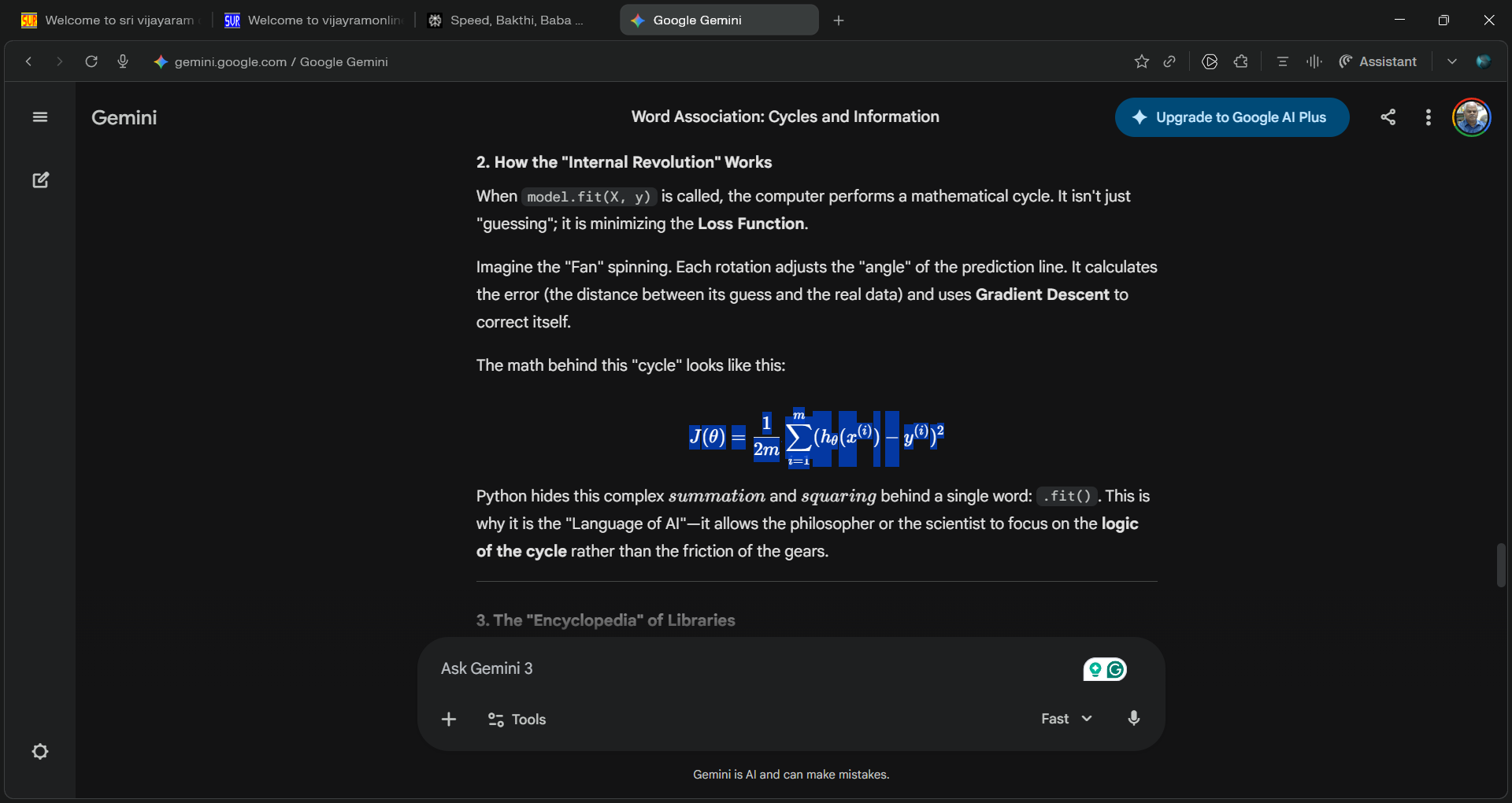 Python hides this complex and behind a single word: `.fit()`. This
is why it is the "Language of AI"—it allows the philosopher or the
scientist to focus on the **logic of the cycle** rather than the
friction of the gears.
---
### 3. The "Encyclopedia" of Libraries
To build more complex futures (like the AI you are talking to now),
Python uses specialized "volumes" of code:
| Library | The Role in Your Philosophy |
| --- | --- |
| **NumPy** | The **Atoms**: Handles the raw numbers (the "coins"). |
| **PyTorch** | The **Nervous System**: Creates deep neural "fans"
that revolve through layers of data. |
| **Matplotlib** | The **Vision**: Turns the internal math into a
visual "encyclopedia" we can see. |
---
### Your Next Step
We just looked at a straight line (Linear Regression). However, life
and "every walk of life" are rarely straight lines; they are usually
curves or complex waves.
**Would you like me to show you how Python handles a "Non-Linear
Cycle"—where the future doesn't just go up, but repeats or
fluctuates like a real fan?**
Python hides this complex and behind a single word: `.fit()`. This
is why it is the "Language of AI"—it allows the philosopher or the
scientist to focus on the **logic of the cycle** rather than the
friction of the gears.
---
### 3. The "Encyclopedia" of Libraries
To build more complex futures (like the AI you are talking to now),
Python uses specialized "volumes" of code:
| Library | The Role in Your Philosophy |
| --- | --- |
| **NumPy** | The **Atoms**: Handles the raw numbers (the "coins"). |
| **PyTorch** | The **Nervous System**: Creates deep neural "fans"
that revolve through layers of data. |
| **Matplotlib** | The **Vision**: Turns the internal math into a
visual "encyclopedia" we can see. |
---
### Your Next Step
We just looked at a straight line (Linear Regression). However, life
and "every walk of life" are rarely straight lines; they are usually
curves or complex waves.
**Would you like me to show you how Python handles a "Non-Linear
Cycle"—where the future doesn't just go up, but repeats or
fluctuates like a real fan?** |